
Printed words
Boxed Set
Paul Francis
Paul is a retired teacher from Much Wenlock with a growing list
of published credits. An accomplished and regular performer on the
Midlands and Borders poetry circuit, his writing, and subject matter, is
eclectic and diverse. Cross- fertilisation between cinema, television,
novels and music is routine and well established.
Surprisingly, poetry has been slow to reflect
the artistic impact of film, and film has only just started to notice
poetry for artistic inspiration (Beowulf). Thus, Paul has
chosen shrewdly to explore poetic territory with a rich seam of
potential which has hitherto been barely explored.
Any such enterprise poses two immediate problems.
Firstly, which films to choose? Secondly, how to present work about
films which the reader may not have seen, or been aware. Wisely, the
choices are mainstream and accessible – Eastwood, Polanski and Jodie
Foster, Cockleshell heroes, African Queen and Sopranos. The
poems themselves are drawn not only from the original works, but also
from commentaries, biographies and gossip contained in the eponymous “Boxed
Sets”.
Half of the collection is devoted to Sopranos
Snapshots in sonnet and sestina. That discipline of form is a
clever device as it forces the author quite consciously to move from one
discipline to another. Sestinas are fiendishly difficult to execute
well, in Tony Soprano, the author pulls off that feat in some
style. The word repetition is perfect for an extended series as is the
sense of inevitability and fate that befalls the characters.
Brief Encounter was the poem which struck
me as being the most fully realised. A poem with a title which has
transcended its original place, and a platform image which is embedded
in cinematic history as a classic, risks falling flat in such august
surroundings, but it soars. It is seen through the eyes of a female
cinema goer:
“She smells the smoky laughs of men
Who scorn romance, but she believes
She is allowed to dream..”
Not only does it speak of the emotions of the
protagonist, it also sums up the authors' desire to dream which he
shares so demonstrably in all the poems.
Boxed Set , the poem, appears as a poetic
epilogue after the Sopranos Snapshots sequence and is both
backwards and forward looking in its position, which is neat. On the one
hand it rails elegiacally:
“Those were the days. A huge, obedient crowd
Feasts on that screen. They just can't get enough
Sighing as one,..”
On the other, in the present day:
“So I stay home alone. It's not a crime
To settle down and lock the door.
I scroll the menu. I shall take my time,
Consider all the options, keep control
Break off ,maybe, for context, background stuff;
Choose what I want to watch, then watch some more.”
And in turn, so the reader will want to read some
more, scroll the menu, and take their time. This collection is immensely
satisfying and I suspect demands a sequel, so substantial is the
material upon which to draw.
Boxed Set is available from Liberty Books, Much
Wenlock TF13 6JQ priced £3.
Gary Longden
Lawn Lore
Nadia Kingsley
Lawn Lore is a wonderful poetry
pamphlet borne out of a brilliant idea. Nadia lives in the countryside
in a rural idyll in Shropshire, but with imperfect grass on her lawn.
One day she was moved to ask a friend who
specialises in grasses to examine a two metre square quadrat. This
involved them both considering in close detail that which previously
would have gone unnoticed, and unremarked upon. This work was created
from that fresh perspective.
The eleven poems themselves are written in
deliberately small print, so small, that unless the reader possesses the
eyesight of a teenage sniper, magnification is required. Nadia helpfully
supplies a magnifier with the pamphlet so the reader may study more
closely her words, as she considered more closely her lawn. A delightful
detail is that each beautifully presented copy is handstitched with a
green thread.
As well as being a poet, Nadia is also a scientist
and her poems reflect the style of a scientific report, yet the writing
is of joyous celebratory discovery. They also consider place, Here
considers how Perennial Rye is selected for Rugby pitches for its
hard wearing qualities, yet her garden offers sanctuary from mankinds'
need to control and manipulate.
Each grass is introduced by its Latin name encouraging the reader once
more to explore further, exploration being the key theme of Lawn
Lore.Ranunculus Repens is the last poem, and amongst the most
satisfying, juxtaposing the childs' tradition of using its flower to
determine a liking for butter from its reflection and its poisonous
qualities- it all depends how you look at it, doesn't it?
The premise for Lawn Lore is startlingly
imagined and lovingly executed in a manner that will delight poets and
botanists alike, as it did me, published by Fairacre Press.
http://www.fairacrepress.co.uk/books/to-buy/
Gary Longden
The Owners
Volumes 1&2 by Carmen Capuano
THE Owners
is the debut series by Bromsgrove author Carmen Capuano the first two
volumes of which are Alone
and Storm Clouds
(Fast Print Publishing – Paperback £10.99 and £8.99)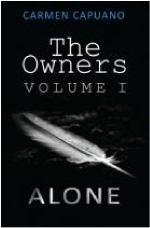
Aimed at teenagers and young adults, as well as a mature audience, this science fiction fantasy imagines that humans are kept as pets, originally unknown to them, and then flickers of consciousness about their situation emerge . . .
Borrowing elements from Andrew Nichol's The Truman Show and Thomas More's Utopia, Capuano develops a good idea well with scope for several more instalments. The time, location, and place are uncertain, but the thematic ambition is bold, an exploration of what humanity is, and as the plot unfolds, what it is not, in a 21st century morality tale.
Pet humans are kept by the Eyons, in a playful twist
on the late 20th century Tamagotchi toy craze in which young
children rushed to buy the Japanese hand held computer virtual pet, and
nurture it.
The second volume, Storm Clouds is
self-contained and opens with cataclysmic storms threatening to
engulf the West Coast of America, leaving twelve year old Dan Ryan no
choice but to be evacuated to New York and into the care of his Uncle
Jack.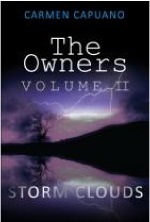
Both volumes are pacy, easy reads, with a fast developing plot that addresses moral questions without being overtly moralising. Storm Clouds has the more conventional narrative, Alone is the more thought provoking with an alien language which borrows from Orwell's 1984.
The familiar terrestrial setting of America is a
more secure setting for the author although having Jack Ryan as a
significant protagonist, a name popularised by Tom Clancy in his spy
series,+ may be a little distracting Stateside.
As a writing debut it is a strong start, and volume
three should be following soon. Capuano feels that there is the
potential to add several more to the series , and I think she is right.
Young readers will be attracted to the page turning storytelling, whilst
older readers will enjoy the time honoured philosophical and moral
dimension which the author revels in tackling.
The Owners series is available from Amazon,
published by Fast print Publishing, signed copies are available direct
from the author at:
carmen.capuano@ymail.com
Gary Longden
Crackle of Almonds
Gabriel Bradford Millar
Awen Publications (paperback) £11.99
GABRIEL Bradford Millar is an American, born
in New York in 1944. She attended university in NY and Edinburgh, where
she read with The Heretics, had poems published in Lines Review and
Scottish International, and has had her work performed on BBC TV. This
collection was written between 1958 and 2011.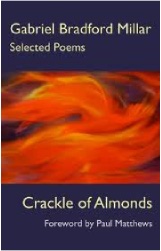
She is married to an Englishman and lives in
Gloucestershire. Previous publications include, Mid-Day ,The
Brook Runs, Bloom on the Stone, Thresholds – Near-Life Experiences,
and in 2001, thirty years of poetry were distilled in The Saving
Flame.
Is Gabriel a good poet? On the evidence of this
collection, undeniably so. Her style is tight and the poems generally
short rather than long. I would describe her language not as rich and
luxuriously descriptive, but more honed, with diamonds of lines, and
pairs of lines, scattered through her poems.
Do I like the poems? This is difficult to answer as
she is a female American writer, and I am a male Englishman – a double
gulf ( the problem lies with me) I have difficulty in bridging.
Although she has lived most of her writing career in the UK I had great
difficulty relating to her work until I hit 2004 when I think she became
Anglicised enough for me to ‘get' her.
The best way I feel I can approach this is to say
whether I think she does what she says in her pitch. In her introduction
Gabriel says that she sees ‘poetry as a matter of recognition: the
listener recognises the poet's experience as something that resonates
within them. I write to pay tribute to the innate savouriness of life'.
My opinion is that the book does what it says it does – and well.
Her favoured subjects are nature, and human nature.
As many of you know, I don't ‘do' nature, I admire much of nature, but
it leaves me speechless – it rarely inspires me to write. A few of
these poems did resonate with me, ‘Pater' for one and ‘You
Have Lain So Long' – which is a beautiful and thoughtful love poem.
Indeed the two descriptions I would choose for her work are thoughtful
and lovingly crafted. For me the perfect poem in this collection (from
the recent period where I can relate more to her) is The Stone Says.
Finally, I have to confess that Gabriel will never
be a favourite poet of mine; however I can see much in this book such,
that for at least some of you, she could be a favourite poet of yours.
Ian Ward
Ian is a Lichfield Poet whose collection “Light and Darkness! is published by United Press
The Suitable Girl Michelle McGrane (Pindrop)
“The Suitable Girl”
explores issues such as grief, anorexia, poverty, expectations within
society and how interior landscapes inform exterior ones through
contemporary characters, myth and literary figures. Eg in “Bertha Mason
Speaks” (from “Jane Eyre”), Mr Rochester's first bride describes how
she'd hoped to be happy and hadn't anticipated the wrench of exile:
“that I floated on a celestial conflagration of
saffron frangipani only to plummet, petrified, into a voodoo tomb; that
within these stone walls time became obsolete: no market days, no
festivals, no seasonal ebb and flow; that mocking echoes dogged this
stifling boudoir and rattled within my bones;
that while I stalked the corridors of the haunted
mausoleum, cinders and sparks showered their benedictions upon me; that
I invoked the shapes of incandescent fever-trees, both eclipsed candle
and hungry flame; hat I sang, blood-red, the island's setting sun,
despite my dislocated tongue.”
Cold reality of England intrudes via the long “o”
assonances which slow down the rhythm and then give way to “i”
assonances in the second paragraph quoted as the rhythm quickens.
There's a passion for language here along with technical accomplishment.
Whilst Michelle McGrane is primarily interested in women's experiences,
not all men in her poems are emotionally cold and unresponsive, “If You
are Lucky” ends
“In the morning, maybe,
soon after sunrise
you will walk barefoot above a waterfall in the forest,
light-headed with the smell of sex,
laughing in your deshabillée.
You will carry
the music of this memory with you
and from time to time,
in the small withered hours,
your body will sing its remembering.”
The poems are not without humour either, in “Space
Gourmet” from the “Lunar Postcards” sequence.
“We season freeze-dried macaroni
with liquid salt and pepper.
Water is distilled, recycled
from our breath and sweat.
After a week of granola bars,
nuts and bitter orange juice,
the commander's arm
begins to look tasty.”
These are lyrical poems that sing with assurance yet
remain exploratory, encouraging the readers to think around the issues
raised and draw their own conclusions. Their descriptions are sensuous,
guiding readers on an emotional journey.
By Emma Lee
Absence has a Weight of its Own Daniel Sluman
Daniel Sluman's
Absence has a Weight of its Own has a mature,
questioning outlook. In “After the Wedding” the couple are
“stalled in the marriage bed;
your maiden name
a peppercorn crushed
in my mouth. A chandelier
hangs above us, the links of the chain
are tiny & numerous, & if one came loose,
if it bent under the strain,
well, I guess what I'm asking is
where do we go
from here?”
The tone is colloquial and the use of enjambment
drives the poem forward making its final question natural and
uncontrived. It's a recurring question. Daniel Sluman looks forward
rather than back, giving this collection a sense of forward motion,
looking towards a future.
The lack of nostalgia-tinged poems based on
childhood memories is refreshing in a first collection. That's not to
say there aren't firsts in “Absence has a Weight of its Own”, eg a first
realisation of being in love comes when a poem's narrator struggles and
fails to imagine taking a strange woman just met to bed as he discovers
he doesn't want to break a commitment to his lover. The past is not
ignored though, “Portrait at a Café” ends
She sips her cappuccino
& floats back to the evenings
when a single line
would catch, spark,
igniting everything down
the months before we met.”
A lover is weighted by her own past and the poet
acknowledges the presence of that weight. As well as relationships,
Daniel Sluman explores trauma and human interactions with compassion,
writing about emotion without sentimentality. The title poem details the
reaction to the loss of a leg,
“Gas flooded lungs tense;
turned spluttering breath
to moth-balled lips
as they cleaved me at the hip;
the flesh was stitched taut,
a finer fabric tore.
Unlike the gold rush of cancer
it entered slowly; grew fat”
There's a finely-judged intimacy here, underlined by
a firm grasp of craft. The rhythm is conversational, welcoming readers
in but the sounds show attention to detail. The clipped “t” assonances
in “tense,/ turned sputtering breath/ to moth-balled lips” echo the
sense of a struggle for breath. These sounds are echoed again in
“stitched taut” interrupting the alliteration in “flesh…/ a finer
fabric”, tightening the rhythm of the longer “f” sounds and making the
reader's breath catch and become shallow as it often does when someone
is in pain. The “gold rush of cancer” sounds relaxed in comparison. I
suspect these effects were a combination of instinct and deliberation
but demonstrate good poetic instinct. “Absence has a Weight of its Own”
doesn't feel like a debut, but a considered, crafted collection.
By
Emma
Lee
“A Body Made of You” Melissa Lee-Houghton
“A
Body Made of You” is a series of poems written
for other writers, artists and strangers working from interviews and
photos or paintings. However, they do not require any foreknowledge on
the part of the reader as each successfully captures the personality of
their subject. In “Dog-mask” from a series about a man called Stephen,
“or a mask with dog teeth
to put on a face that women won't want then
to sit on your lap and be rocked like back when
you were king of tides and waves of orgasms.
I will ask you to wear your mask, like me,
and I'll keep my dress on and my sensible shoes.
But I imagine first that you will catch your real
face
in one of those mirrors I should've smashed –
and then I just know that you'd cut off your nose.”
The poem captures the essence of a passionate,
troubled man with the last stanza hinted at the humanity beneath the
womaniser. It touches on the fact that portraits can only capture one
facet of a person and can be manipulated to keep a public image that may
be different to the private image. This issue is explored in other poems along with the relationship
between artist and sitter, in “Clowns”, about Nate,
This issue is explored in other poems along with the relationship
between artist and sitter, in “Clowns”, about Nate,
“We're going to have to do
something drastic. I just can't see you
in spandex, riding the trapeze anymore.
Why, when I say take off your clothes, why do you insist
on wearing clown shoes. We're not playmates:
I am an artist. You ask, so why can't artists laugh.
I am lonely and infuriated for not
finding ways of making art of you and I
You do not love what can't be made light of -
but I'm a cold mirror; you are afraid;
and when I sit still, like I did in class
you come towards, quiet, get braver, closer;
I am the kind of animal that could never be tamed –
you would like to pull my hair but instead you mark
two thick black crosses on my eyelids.”
There's a reluctance in the sitter to be stripped
bare what he feels makes him himself, he needs to keep his clown shoes
on. He needs to know others will see him as he sees himself and a desire
to imprint on the artist his own vision. He is fearful of what the
artist will show of him, defensively insisting he can't be tamed. That
relationship between sitter and artist is also explored in “Still” about
Annie
“when winding a hand to manipulate the brush, the
paint
to fit your shadow, that does not show
pounds and ounces, greying hairs, or a terrified pubis.
Trust me, Annie, I am not a man, and my art will not seduce you.”
There's a sense of protectiveness, the soft “s”
assonances and feminine endings on the last three lines quoted echo that
sense. “Broken Poem”, about Alexandra, has a sense of exuberance.
“her daddy gave her
the big red heart of a painter
and it makes mine less blue,
her brother bought me
a sari covered with
empires of stars
when i was broken
yes, love flayed our nerves,
made us sensitive –
i like it when she
wears crimson
no padding in her bra
no eyeliner just
her flame-red daughters
flopping in her lap like puppies
in the low chair.”
The passion and energy suggested by the repeated use
of shades of red have an energy and it's no surprise that the painter
likes her subject best when she stops being all things to everyone –
daughter, sister, wife, mother – and takes time out to momentarily be
herself.
What's striking about “A Body Made of You” is the
depth of exploration of subject. The poems do not become formulaic, but
start from their subject whose personality guides the tone and style of
the poem, from the enjambment and energy in “Broken Poem” to the gentle
protectiveness in “Still” and the intricate showing in “Clowns”.
By Emma Lee
Aly Stoneman is concerned with
landscapes both in the actual countryside and the landscape of a
poem on the page. “Mermaids” starts,
“I walked a blank white page
between scarred headland
and storm-line heaped with weed
and litter, stinking of the sea.”
A stanza which manages to move from intrigue, “blank
white page/…scarred headland” to the more banal “heaped with weed/and
litter, stinking of the sea”. The seaweed and stench were doubtless
there but their presence is predictable and the stanza doesn't offer a
new way of sensing them or use them beyond observing them.
In “Wyld” there's a countryside walk where the “we”
of the poem are not identified and their relationship is not spelt out
either so readers don't know if they are friends or lovers. Perhaps the
poet's intention is that it doesn't matter.
“We paddle and wash near Bigsweir Bridge;
canoeists greet us, swans observe us.
At Lower Hail after dark, outstretched
on a platform of flat stones, we seem to sail.
Bright stars are not police helicopters,
nor owl-calls the screeching brakes
of stolen cars. Satellites flare and dim.
Conifer trees are sharp black cut-outs
against constellations we cannot name.”
The poem ends with the walkers catching a bus and
going their separate ways, “waving until you vanish in the heavy rain.”
The walkers are urbanites enjoying the country and the contrasts between
natural sounds and artificial city sounds. Look how passive it is,
“canoeists greet us, swans observe us,” “we seem to sail,” the list of
observations. It feels as if the reader is being kept at one remove,
distanced from the action by the passive voice of the writing. This is a
shame as the writing shows awareness of craft but appears to be
searching for a subject it feels passionately enough about to ditch the
passive voice in favour of an active one.
By Emma Lee
“Someone Else's Photograph” Jessica Mayhew
Jessica Mayhew is interested in the other and
people external to the poet along with a sense
of family inheritance. There are poems about relatives and friends,
other people, neighbours' gardens, the sea, exploring people's reactions
to the actions of others or their landscape. Although the poet is
present, she is often not the subject of the poems. For example in “Pub
Lunch”
“A bee trickles on the lip
of your glass. You swat and miss,
 sending
it into shivering flight,
sending
it into shivering flight,
unseaming chubby jointed legs, coarse
yellow hairs. Unhook the sting,
until all that is left are the quarks
which tumble and fizz like pollen grains.
You're not listening, you say.”
Readers don't know who the “you” is but they are
ineffectual, neither engaging the poet nor successfully swatting the
bee. The bee becomes a metaphor for them: the clumsy flight as clumsy as
the efforts of “you” to engage the poet/narrator in the conversation.
Not all poems have a air of seeming inconsequence, in “The Great Ocean
Road Motel”
”Here is a dark beyond the dark you've known,
and that sound will go on uninvestigated
you think, and lie on the top sheet, fully clothed.”
There's a sense of menace without over-dramatising
or labouring the point. “Someone Else's Photograph” demonstrates skill
to complement talent.
By Emma Lee
The pamphlet's title is a word made up by the
poet's son, who also features in the poem
“Rose,”
“arms flung above his head,
a mirror of his mother.
Their murmurs and breath
float from open lips
his a perfect miniature
of her own sleep-slackened rose.”
Although the poem holds sentiment, it is not
sentimental and sets the tone for the rest of the pamphlet. There's only
a couple of baby poems too, Roy Marshall is clearly aware that other
won't share a parent's fascination for their own child. There are
touches of childhood, in “Egg”
“‘The baby bird will die,' she says,
‘it's [sic] mother will leave because of your scent.'
I tip it warm and blue, into the nest,
walk to the classroom, my face hot and wet,
the world off kilter.”
Again there's a demonstration of control and
allowance of space for readers who are not told what to think. The
actions are allowed to speak for themselves.
 The
tone of softness in “I tip it warm and blue, into the nest” contrasted
by the instructional tone of “walk to the classroom” echoing the change
in mood from a optimistic taking a chance the bird will accept the egg
despite its being tainted by human scent to the pessimistic “world off
kilter”.
The
tone of softness in “I tip it warm and blue, into the nest” contrasted
by the instructional tone of “walk to the classroom” echoing the change
in mood from a optimistic taking a chance the bird will accept the egg
despite its being tainted by human scent to the pessimistic “world off
kilter”.
“Gopagilla” doesn't just offer personal poems
either. “Records on the Bones” is in the USSR where underground presses
printed flexi-discs of American Jazz records on discarded x-ray sheets
often leaving the x-ray visible.
“grooves cut into opaque femurs,
hair-lined metatarsals and wrists,
furrows on fields of cranium, long since gone to ground.
Smuggled under over-coats through the streets
was the promise of jazz, sleeved between
twilight and heartbeat,
carried up back stairs to box rooms where
the snare flitted like sun-light through a line
of freight; this is how St. Louis and all its saints
came to Leningrad, in the bootlegged sound of those
who were born as slaves, musicians who drew us along
in the wake of all that western decadence.”
“Gopagilla” demonstrates a firm foundation for
future collections from a poet who appreciates the need for poems to
communicate with and offer space for readers. Available from
Crystal Clear Creators.
By Emma Lee
Charles Lauder concerns himself
with human interaction with landscape, eg in “In This House”, contrast
the “lush green safari-land” of happy children with the bees and weeds
of the isolated children:
“The division cuts through the house in zig-zag
fashion
one side lush green safari-land with the rhythm of locusts
beads of sweat row upon row lining up
to ski down the young backs the other side cordoned off
behind closed doors in cool isolation
where the children flee from the bees
and the heat and pulling weeds in their father's garden
feet sticky and stained with grass camping out
in front of the TV all morning long. The same division
as at night when the children are ushered back
to the other side to bed the muffled peals
of their parents' party seeping through
the wall and humidity rolling in
through the open window over their bare chests.”
Spaces are used to suggest caesura, a guide to both
reading aloud and the sense of the poem. The weeds are both literal,
there are weeds in the garden, and metaphoric, the parents regard their
children as weeds diminishing their adult lives.
There's also an interest in ancestry and
inheritance. In “Black Dutch”, a illegitimate boy who was put up for
adoption grows into a man whose
“workmates called him Andy
and his wife called him Carl
to his children he was Daddy
and to their children Pa-paw
I was the love child of a German doctor
and his maid he told the family
but by then the secret had circulated
the room Black Dutch coming to mean
Jew Comanche Mexican
but to his mother who taught him to fish
shoot drive a car at twelve and make
bathtub gin who hadn't the heart to tell him
he wasn't hers until after he had married to her
he would always be my little nigger baby.”
His unknown origins make him forever an outsider,
given different identities by different people and never quite
completely whole.
As a Texan living in England, Charles Lauder is
aware of the desire to be part of a new community whilst not losing
sight of his own origins. The poem's rhythm and layout are influenced by
contemporary American poetry where end of line pauses are slight and one
line often runs onto the next. Spelling is mostly English with an
occasional Americanism slipping in. The combination works and the themes
are sustained for the length of a pamphlet. However, for a full
collection, I'd like to see more experimentation, a break from the
sameness of tone and rhythm.
“Bleeds” is available from Crystal Clear Creators.
By Emma Lee
“Citizen Kaned” Andrew Mulletproof Graves
Andrew Mulletproof Graves is
firmly rooted in his native Nottingham with poems about local heroes
such as Brian Clough and Alan Sillitoe but uses it as a base to explore
broader, international themes. His heroes are flawed, a product of their
circumstances, for instance Rondo Hatton (1894 – 1946), an actor who
suffered with feature-distorting acromegaly in “Not all Monsters Come in
Kits,”
“And the studio had you
cheap, playing for your disease
your Hyde face untouched by
potion or mythology.
Bathed in lights of the surgery
via Hollywood creeps and monochrome
into nature's callous make-up bag, a
ghoul of doomed integrity.”
There's empathy here and a natural ear for rhythm,
as readers would expect from a performance poet. “Johnny” doesn't need a
surname:
“takes on the crowd in a pincer attack,
the Country boy bleeds and he bleeds black.
Wears his coat like dark brushed skin,
whip-smart, piece of art, vampire thin.”
Although the details are specific to Johnny Cash,
the poem draws a picture anyone can recognise. In contrast to “Not all
Monsters Come in Kits”, which uses feminine endings suggesting
compassion and empathy, “Johnny” uses masculine endings and full rhymes
supported by internal rhymes to produce a muscular effect.
I don't draw any distinction between “performance”
and “page” poetry. Genuine poems work both in performance and on page
because the poem's elements of words, sounds and rhythm complement each
other, creating a result that's more than the sum of its parts. In
“Citizen Kaned” Andrew Mulletproof Graves shows he can both perform and
write.
The
Crystal Clear Creators pamphlets were produced via a mentoring
scheme where established writers mentored writers who hadn't yet
published an individual collection. Andrew Mulletproof Graves was
mentored by Deborah Tyler-Bennett, a fitting partnership as both share a
home town and both with a keen ear not just for words but the sound of
the words too.
By Emma Lee
Abegail Morley's second collection
focuses on a sense of loss and relationships, effectively using a
sparse lyricism. In “I learn this from him” where he has written
“love poems with loops and doodles around the
borders.
He says he'll read them to me some time. I realise
this means
I'll be coming back. The coffee is strong, slightly bitter,
grainy at the bottom of the cup – dries on my tongue.
He runs his hand down my cheek. I think he'll put
his thumb
in the dimple on my chin, but he doesn't. I feel
the touch of his fingertips on my collarbone.”
The poem captures the sense of a doomed
relationship, not just in the bitter dregs and reluctance tor return but
also in his actions: he's reading love poems not written for her and
that controlling action of fingertips on her collarbone.
The title poem is worth quoting in full:
“I didn't think you
would exist this much,
not now, not with this snow.
You are unborn,
you are not my child.
I did not extend life to you.
You spit my name;
a tiny ball of phlegm
keeps itself in a tight circle.
I retch.
There are teeth in it.
It has a possessing smile.
Frost has spoken to you,
it has a soft sound.
Its mouth is small.
I lost you to a glass jar;
you have a fin and a tail.
You sleep.
I hear you breathe.
I didn't think your breath
would be this warm.
You are too cold.
The ice found you –
it erased your fingerprints.”
With the exception of stanzas three and four, each
is built around long vowel sounds, creating a soft drawn-out feel
fitting with the theme of grief and loss. Stanzas three and four are
built around shorter vowels and harder sounds, echoing the change in
mood and capturing anger and denial. The change from speaking of the
snow child in second and then third person and then back again to second
in the fifth stanza further underlines the mood. The poet is firmly in
control and all the elements within the poem complement each other.
“Snow Child” contains focused, controlled poems that
demonstrate poetic skill and a precise use of language to achieve poetic
aims.
By Emma Lee
The title poem firmly sets the
scene, as the house empties and becomes still,
“It looks simple: the glass vase holding
whatever is offered –
cut flowers, or the thought of them –
simple, though not easy
this waiting without hunger in the near dark
for what you may be about to receive.”
Like the title poem, the others also use a simple
but precise vocabulary. The focus is in the stillness before the drama
and tumble of family life. This focus gives the reader plenty of space
to read and think around the poems. Yet the poems have been worked over
with the finesse of “The China-mender's Daughter” explaining,
“how he'd check for veins of damage
lifting each piece of fine-bone to the light,
how it flared, translucent,
in his fingers – a hare's ear
shot through with sun.”
No veins show and, like the fine-bone china plates,
appear delicate yet are robust enough to take the weight of a Sunday
joint or a stodge-laden pudding. It would be easy to write off “This
Morning” as simply a domestic still life,
“the iron frying pan gleaming on its hook like an
ancient find,
the powdery green cheek of a bruised Clementine.
Though more beautiful still was how the light moved
on,
letting go each chair and coffee cup without regret
the way my grandmother, in her final year, received
me:
neither surprised by my presence, nor distressed by my leaving,
content, though, while I was there.”
It's a spot of time, a grandmother happy to accept
her granddaughter's presence for as long as her granddaughter is
prepared to be there, knowing that surprise or distress might deter
future visits. The grandmother, like the poems, understand the ebb and
flow of family life and the importance of staying in the present,
letting go of the past and only worrying about tomorrow when it comes
today.
“Grace” is a masterclass in control and the
necessity of finding the right word, even if it's a simple one, allowing
readers to see the commonplace in a new light.
By
Emma
Lee