Turn of the Screw, written by Henry
James in 1898, is an essential component in the canon of English
literature adapted for stage here by Tim Luscombe.
It is co-produced by Mercury Theatre Colchester,
Wolverhampton Grand Theatre and Exeter Northcott Theatre, and directed
by Daniel Buckroyd. At under two hours running time, with Act one at
forty- five minutes, and Act two at fifty, it does not waste a moment.
Although a hundred and twenty years old, the tale
has lost none of its snap, crackle and pop and Luscombe's vision is
bathed with Gothic splendour.
Originally a horror novella, it first appeared in
serial format, in twelve parts, in Collier's Weekly magazine
(January 27 – April 16, 1898). In October 1898 it appeared in The
Two Magics, a book published by Macmillan in New York City and
Heinemann in London. James revised The Turn of the Screw ten
years later for his New York edition and subsequently made several
changes including the children's ages.
Classified as both gothic fiction and a ghost
story, the novella focuses on a governess who, caring for two children
at a remote estate, becomes convinced that the grounds are haunted.
Modern audiences may see this as purely a ghost
story. Yet when it was originally written, Spiritualism and the
supernatural were mainstream concerns. Henry James was a member of the
Society for Psychical Research, which was established in 1882, a body
replete with academics, philosophers, and scientists, which survives to
this day.
The story pivots on whether what we are seeing is
real, or in the imagination of the Governess. Evil hovers, confusion and
suspense abound. Luscombe offers no answers, his adaptation simply
strengthens the ambivalence of the conundrum.
The intrinsic strength of the tale has seen it
retold on numerous occasions, and on every platform; radio drama, film,
stage, opera, ballet, and television, including a 1950 Broadway play,
and the 1961 film The Innocents.
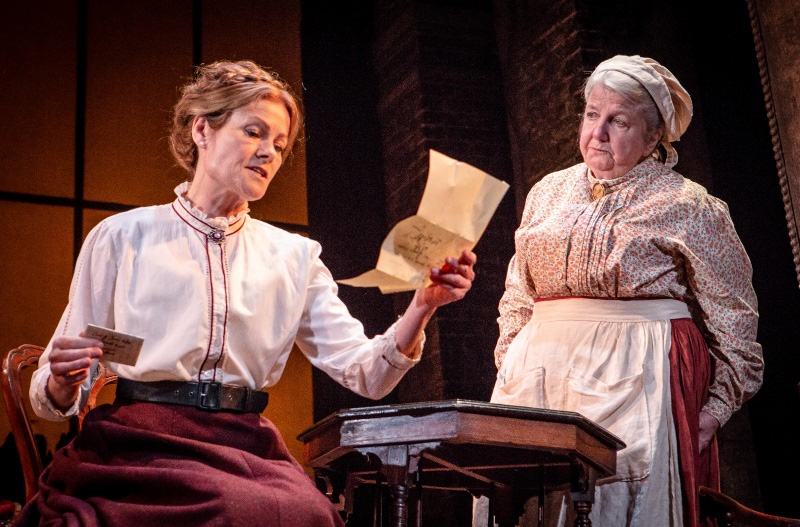
A four hander, the parts are played by Janet
Dibley as The Governess, Amy Dunn is Mrs Conroy, Mrs Grose is played by
Maggie McCarthy and The Man is portrayed by Elliot Burton, with the
children very effectively played by adult actors doubling up.
Dibley, best known for her work in The Two of
Us, Coronation St and EastEnders, is compelling at the
centre of the strange and sinister tale, her character seemingly always
on the edge of insanity. Her opening interview with her prospective
employer, is a masterpiece in controlled manipulation. Dunn, McCarthy
and Burton are superb, balancing melodrama with razor sharp tension.
This is part ghost story, part psychological
thriller, but eschews stereotypical ghosts. Instead the ghosts are eerie
extensions of everyday reality, with the exact lines blurred.
The stage features an irregular, offset, set,
innovatively conceived by Sara Perks and spookily lit by David Kidd. The
amount of light in scenes shadows the strength of the supernatural or
ghostly forces apparently at work. John Chambers provides a classic
soundscape full of discordant notes, jolts and bangs. Period costume,
delightfully realised by Ella Clarke, and set, meld perfectly, in a
beautifully presented production, rich to the eye, menacing the soul.
A rocking horse is revealed at curtain up, in
motion, with no-one else around. From then on, the mystery and suspense
is meticulously layered, teasing, and tempting the expectations of the
audience.
Luscombe asks to believe both the proposition
that the governess is mad, and that the ghosts really do exist, and
consider both dreadful implications simultaneously. The exact nature of
the evil alluded to is unspecified but sexual violence and coercion seep
from the pores of this powerful production. Director David Buckroyd has
fashioned a gem of a show which runs until Saturday 11th May.