|
|
|
|
|
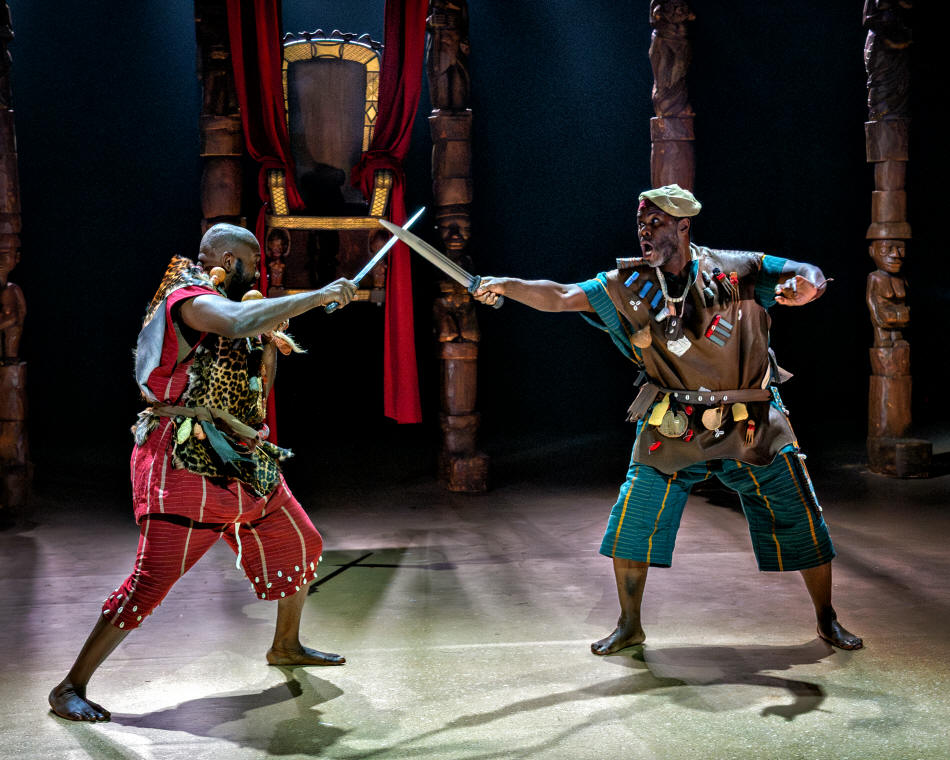
Deyemi Okanlawon as Aderemi and Mo Sesay as Ashadele. Pictures: Robling Photography Crown of Blood Coventry Belgrade ***** Shakespeare – as you’ve never seen him before! Utopia deserves surely to be viewed as one of the most exciting, astonishing and inventive companies in Britain – perhaps internationally - today. Its latest play, Crown of Blood, easily and unmistakably confirms it ranks among the very best, most creative, daring and imaginative of current UK theatre. To call it stupendous would be an understatement. Sheer, unadulterated excellence. Wonderful individual and group acting. Imaginative direction. Vividly conceived set. Glorious costumes. Powerful lighting. Ingenious, harrowing script. Everything about the production superb. It exemplifies to perfection Utopia’s commitment to reveal – and how! – the rich cultural and artistic heritage of modern Africa, and to bring it to new and established audiences alike, drawing in and empowering members of the African community here, encouraging young performers and sharing authentic stagework with huge intelligence, relevance and insight to excite and – yes – to thrill a fresh generation. In its way, Utopia is a revolution. Supported hitherto by the National Theatre’s far-sighted, nationwide and enabling former ‘Generate’ Programme, and directed with vivid imagination and awesome mastery by Utopia’s Founder and Artistic Director, Mojisola Kareem, Crown of Blood is their striking, innovative adaptation of Shakespeare’s masterpiece, Macbeth, by Oladipo Agboluaje (his extensive theatre arts credits include the University of neighbouring Benin – also Yoruba speaking - the south west province of Nigeria). Marvellous; scintillating; dazzling; erudite; wise; inspired. It's certainly Shakespeare as you’ve never seen it before. Absolutely. But to wonderfully good effect. Agboluaje’s Crown of Blood is a freshly conceived, superb new Yoruba (Nigerian) version of Macbeth. The Scots usurper is here a triumphant Nigerian General, Aderemi (the magnificent Deyemi Okanlawon). Following a crucial victory, he is promoted to Field Marshal (Cawdor), thus fulfilling the prophecy of an unnerving oracle. For far more importantly, the sinister, corrupting oracle says Aderemi will later become King. Thereupon he and his wife Oyebisi embark on a bloody mission to ensure he sits on the throne.
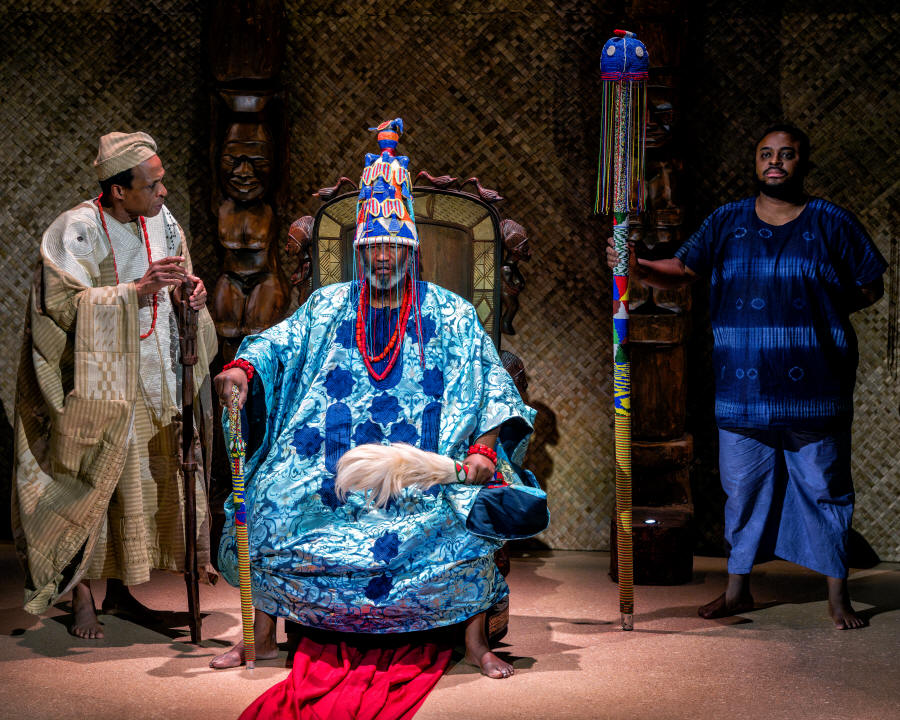
Jude Akuwudike as Opaleye and Patrice Naiambana as Iwalagba Set a century or so ago, it might remind us of the late 1960s northern leaders’ assassinations, or Ojukwu’s ensuing coup and partition of southeast Biafra. But interestingly, the Yoruba speaking (western) region, and Ibadan, under Obafemi Awolowo and others, was least affected. There were tensions, but by comparison, things remained quiet. The way the story is structured works splendidly for numerous reasons. Agboluaje has filleted the Scottish story, paring it down in parts yet opening it up and expanding it, giving it challenging new angles and compelling emphases to provide his twelve fabulously polished actors with richly expressive, visibly contrasted roles: endowing them to great effect with remarkably differentiated personalities and opinions. Shakespeare gives us Thanes. In this version right from the start we encounter mostly the ruling King’s bustling counsellors - Patrice Naiambana, Deyemi Okanlawon, Adeniyi Olusola Morolahun and their bewildered comrades - all vivid and convincing characters, splendidly clad in scintillatingly different colours (yellow, beige, blue, green etc.), one or two of them slightly crazy, and crotchety, with hunched shoulders or limping walks; and who in most cases - all of them incisively directed - will in due course, cowed by the dictator and enjoined to pay homage to the (initially hesitant, even reluctant) usurper, Aderemi and his ambitious, unscrupulous, unrelenting Queen. We only know their African names, but one at least is designated ‘Prime Minister’, and admirably played, he shows some leadership as his subordinates begin to feel serious doubts. When the oracle predicts Aderemi (a wonderful, shivering and interestingly ambivalent performance throughout by Okanlawon) will become King she emerges to grieve over her husband’s body. As in Shakespeare, she is more ruthless.
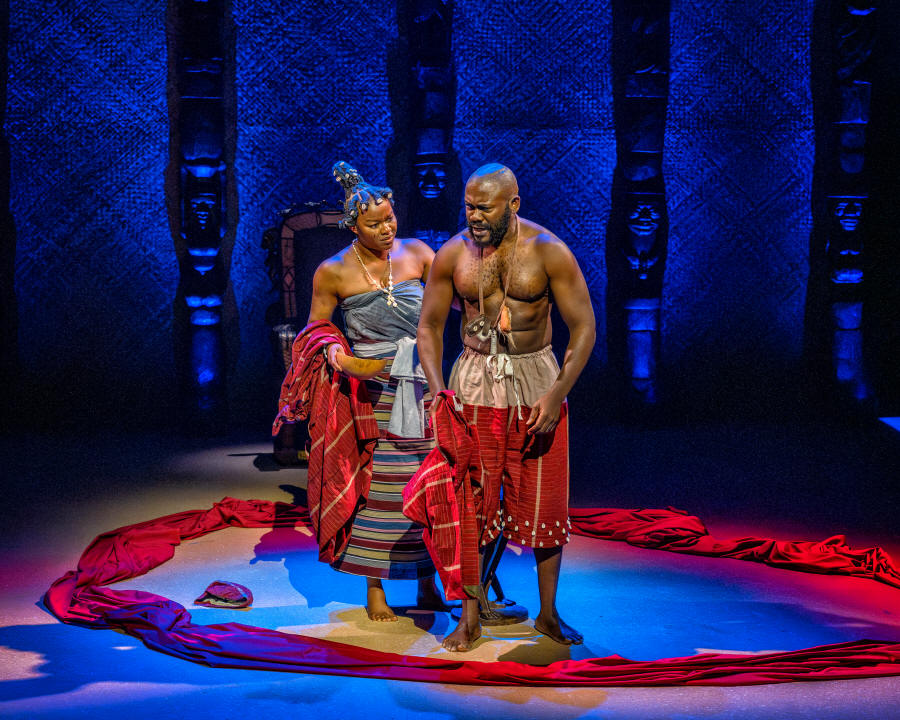
Kehinde Bankole as Oyebisi and Deyemi Okanlawon as Aderemi Sinister, thrusting, brutally ambitious, the Queen is splendidly depicted by Agboluaje. It is she (Kehinde Bankole, wonderful) who, at the outset, seizes on the spirit’s prediction that her husband will be king (and hence she, queen). She is furious with a shivering spouse – supposedly a top warrior - for killing the King’s supposed servant assailants. She has to take a grip on him at every crisis. We don’t get the sleepwalking and handwashing scene, nor does Lady Macbeth predecease her husband. Instead, we witness a fascinating final sequence. She lives to see the grim consequences of her own actions. Yet in a strange way this is rather moving. The costumes are astounding. From the start we are awed by a huge crown, not unlike a papal headdress. Presumably the Duncan figure of the royal ruler initially, the crown will be assumed by Aderemi once the murder has been enacted, when he and his wife appear in identical red garb (the use of scarlet lighting at key moments is just one of the highly effective visual aspects). Aderemi (Okanlawu) is sturdy, burly, powerful, sometimes rather passive and tolerant, but increasingly threatening. Macbeth’s opening witches don’t appear till later, when three eerie and ugly crawly creatures seem to echo the original. However the camaraderie between Aderemi (the superb Okanlawon) and his fellow general is well established at the outset – and part of the messenger’s graphic retelling of the outcome (Thane of Cawdor) is faithfully included, setting the play in faithful form. Later we don’t witness the killing of MacDuff’s family, but we hear of it, and the suffering is beautifully depicted. The eerie killing and exit of a wholly pure, white-clad predecessor, is vivid, like so much in this production. And we even hear – that famous moment in Shakespeare - from a servant that the wood is advancing on Aderemi’s castle. This, the prelude to a graphic, fiercely engineered and, for the audience, unnerving sword fight in which the usurper and murderer finally succumbs. The quality of this beautifully articulated staging, so truly gripping, its endless moments of subtlety or intimacy, of ranting or plotting or conniving, is never for a moment in doubt. What astounding talent. What power of alarm and daring. What innovative brilliance. No doubt about it, Utopia is British theatre at its very finest. Roderic Dunnett 02-26 |
|
|
|