|
|
|
|
|
|
Bella Bartels' Juno (in turquoise, left), keeping
a watchful eye on a rampaging gaggle of Gods. Orpheus in the Underworld Royal Birmingham Conservatoire **** Orpheus in the Underworld (Orphée aux Enfers) was a good choice for to undertake. With a libretto by Ludovic Halévy (nephew of the prolific composer), and Hector-Jonathan Crémieux - both of whom Offenbach collaborated with a dozen or more times, it’s funny (at times hilarious), clever, fast-moving, in places markedly subtle, a delicious piece in so many ways. By 1858 Offenbach was on his 30-plus opera (of nearly 100, can you believe it?) and it remained, if not his favourite opera with the Paris audience, certainly one of the most popular. With this helter-skelter production, of 13 (sometimes 16) lead roles plus hefty chorus, you could see why. First to mention, and to some extent the outstanding feature was the 19-strong orchestra conducted by the mastermind behind these natty productions, Paul Wingfield (I saw – and praised – his/their Cendrillon a few seasons ago). Time and again their vivid, energetic, sprightly playing had one gasping at their talent, their vitality, their poise, their ability to capture precisely the rhythm every time. From the very inspired oboe (Mary Glasby) early in the very exciting, well managed overture starting the high jinks, and on three or more moments when her lucid, distinctive playing was exceptional. But others shone too. Indeed, the solo alluring and playing, wherever required – one or other of the horns, for instance, or at one particular point, the eloquent, intimate bassoon (Shosha Yugin-Power) - was sensitive, precise and atmospheric. The three other brass were terrific. There was a lot of intelligence, even insight, in all this orchestra’s playing, and in cheeky Offenbach, nurtured, coaxed and inspired by Wingfield, all came off really vitally. Because of these numerous good qualities, the several splendidly crafted interludes the composer intersperses between scenes were genuinely vital, superbly managed and cleverly manipulated, indeed memorable. Where Offenbach danced (there’s quite a lot of that, balletic in fact), they really took off and danced to perfection. In short, an orchestra, really professional, idiomatic, and at every point deeply satisfying. Highly impressive. Wizard in fact. Easy to pick out others: the paired clarinets, the cheeky piccolo (Sophie Wood), the horns and whole brass section, and believe it or not, just a quintet of strings, all ideally balanced, clustering (never overbearing, though explosive where interludes required it), in a side hall of Birmingham’s ‘Gas Street Central’, a strikingly congenial and appropriate – and voluminous - concert venue still primarily functioning as a church (St. Luke’s), and which served this adventurous operatic undertaking, give or take limited, occasionally cramped stage platform space, admirably.
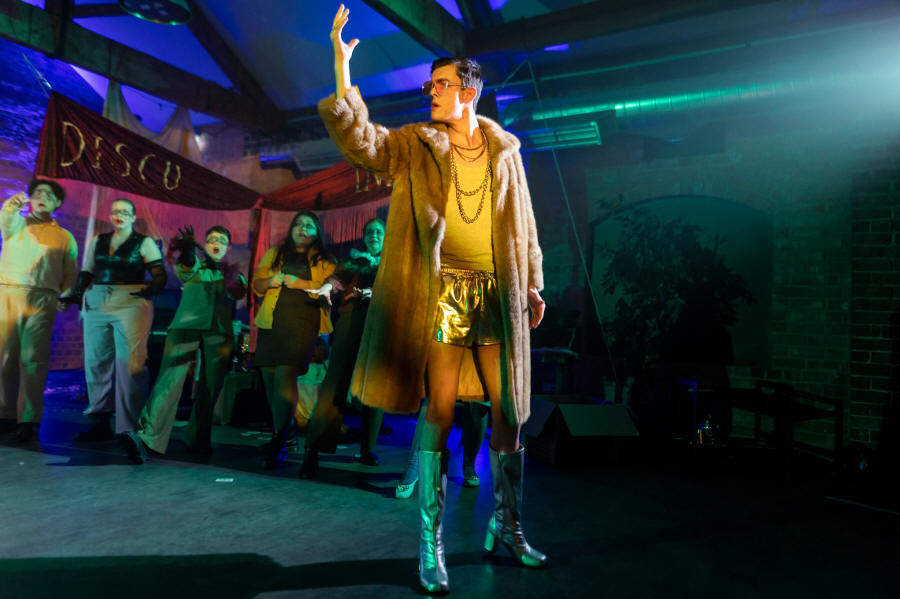
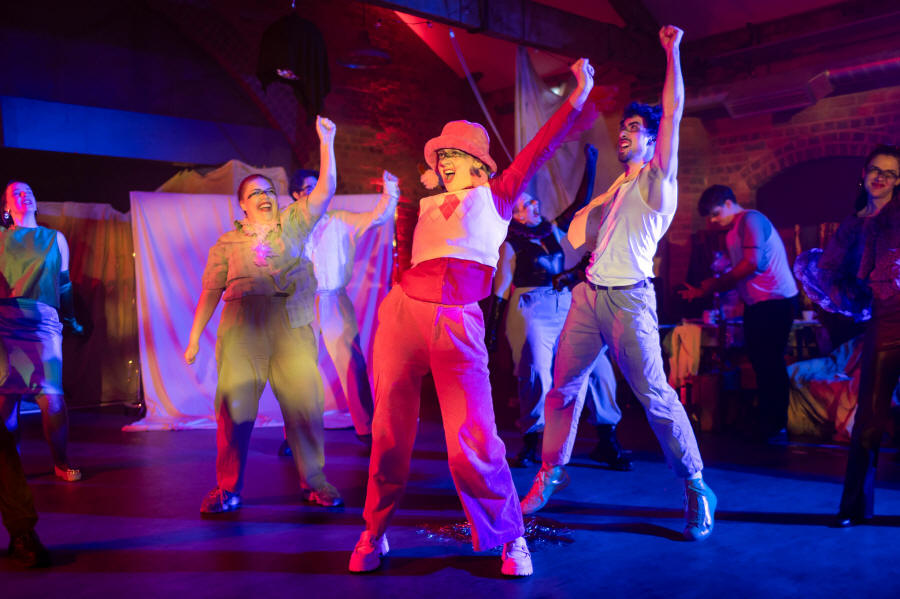
So, what of the singing? One’s sole criticism, if there must be one, is that the delivery, especially early on, was arguably loud for the venue, with the audience so close. It called for subtlety, and was, here and there, rather belted out. There were pleasing exceptions: Sydney Suffield’s trouser-suited Minerve, for instance, had this crucial quality, lending variety and subtlety to the sound. But the whole cast (their second cast) merited praise for capturing the spirit of this opéra bouffe. The chorus’s singing (not acting), incidentally, was superb. Strong, precisely together, exciting. And they achieved, too, delightful sounds offstage. High marks. The highlight amongst the leads had to be William Swinnerton’s authoritative, increasingly bonkers Jupiter. Not just when he doffed his ample fur coat and donned hot pants and a silver outfit in the forlorn hope of wooing Eurydice, but from the very start. Here is a bass voice of such enormous vocal quality – not least in an opera featuring seven or more female roles. Offenbach’s King of the Gods needs to be magnificent; Swinnerton was just that, even when he is fooling around. Here also there was vocal variety: he too was not too domineering, and everything about him paid off: great casting. We meet Eurydice early on, and Phoebe Curcher’s gift for hitting high notes (Offenbach litters her role with those) became obvious the moment she started singing. Her delivery was forthright, determined, insistent, and she from the outset showed how polished this cast’s singing in French was. Her speaking – Orpheus is in effect what the Germans call Singspiel – was first-rate too. That was a quality of Joe Yates’ Orpheus too: his singing not overpowering (a welcome quality), and his dislike of delightfully evident, though his acting, fey and a mite camp, made less impact than hers: a bit weedy. No comparison with Andrew Woodmass-Calvert’s Pluto (Aristaeus), whose tenor, often in lower registers, captured the imagination vividly. A slick and entertaining actor, with a fine, resonant voice; a treat every time he appeared, and his well-thought-out acting was easily one of the best. One of the unmistakable hits was Millie Royle’s Cupid – the best costume (all pink?) and delightfully lively. Equipped with a beautiful, even sensational, voice to match her vibrant personality and imaginative performing, she shone brightly, As did her rival messenger, Mercury (Sebastian Sgouraditis in both casts). Notably well delivered in both speaking and singing was the curious narrating figure ‘Public Opinion’(mezzo) inserted by Crémieux and Halévy (Jade McLellan), who cheered up the stage mmasterfully. A star performer.
No one missed the boat. As mentioned, the singing was uniformly good: Matilda Wale as Diana (again, enhancing both casts), Laura Csiki’s scrumptious Diana, and Bella Bartels unloading almost unforgiving power (apt) as Juno (who is, after all, Jupiter’s cheated-on Queen). Styx, the boatman (Charon), is not a large part, but Oscar Curtis gave him some character, teasing, moody and gruff, alongside Joshua Thompson’s eager Mars (also cavorting in both casts). So, amidst all this applause, where was the drawback? It was, I’m afraid, in Rebecca Meltzer’s directing, abetted or arguably hindered by Jennifer Gregory’s nearly non-existent set. Meltzer has a phenomenal record, directing at every major festival and venue, but her skills were little evident here. Why? The ‘stage’, consisting of merely a single small platform, offered little. A large double bed, with a direly pastel-patterned, second-hand looking counterpane, took up a considerable part of this; hence moves for the leads were restricted mostly to front of platform delivery; when the chorus amassed on it, their appearance and arrangement made – or could make – no impact at all. A dour brown curtain soared above stage left – whose value proved itself only to mask Jupiter and Semele when effecting their (admirably quick) clothes changes. But it might instead have, to considerable advantage, offered scope for some kind of modest third, or upper level. Exits and entrances, bar a couple through the audience, were thus of little interest in themselves. Gas Street is a vast area. It cannot be said it was well used; indeed, there seemed little invention, let alone imagination, in the whole staging. To better effect was a handful of Heidi Ashford and Megan Cleaver’s occasional Props. One longed for a bit of ingenuity. The whole affair onstage was troublesomely ordinary, rather dull, the choir’s chatting and to some extent, gesturing to one another, tediously amateur, devoid of tangible ideas. So: music marvellous; production workaday. It could have been, and needed to be, so much more subtle. Too much was dull. Roderic Dunnett 03-26 |
|
|
|
,%20keeping%20a%20watchful%20eye%20on%20a%20rampaging%20gaggle%20of%20Gods.jpg)