|
|
|
|
|
Dirty Dancing
Wolverhampton Grand
*** SO did we have the time of our lives? Not
really. It was an entertaining evening and a watchable production but
never quite lived up to the billing of its ancestor, the iconic 1987
film. The low budget ($6m) musical romance with Patrick
Swayze and Jennifer Grey became a huge hit and was the first film to
sell a million copies on video, as well as spawning mega selling albums,
so this new production had a lot to live up to. People, rightly, expect to see the story they
loved in the film retold faithfully on stage, but cinema and theatre are
different beasts and what works on screen doesn’t always translate well
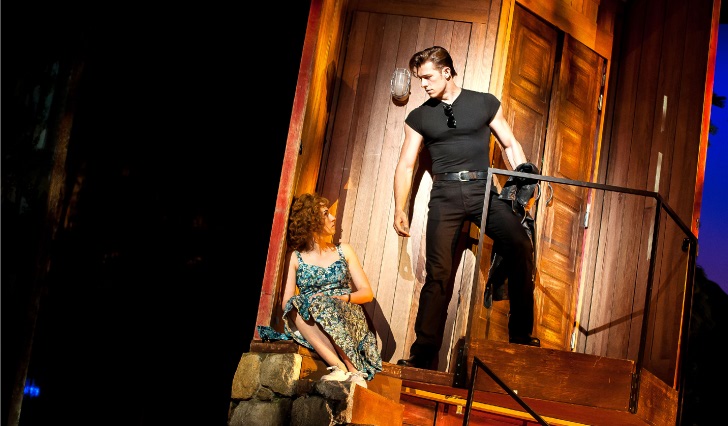
beyond the footlights. Roberto Comotti's design is quite masterful with
three rotating structures which provide first, in the centre, the main
block at Kellerman’s mountain resort in the Catskills, providing both
the ballroom inside and, rotated the outside façade; then there are the
staff quarters and their bedrooms rotatingat one side of the stage with
the Houseman cabin, and bedrooms rotating on the other – all beautifully
lit by Valerio Tiberi incidentally. Scene changes are seamless and rapid, taking only as long as the cast leaving and entering, but you got the feeling that the film was being followed too closely and as many scenes as possible were being crammed in, some for little more than a few seconds which meant at times the set seemed in constant motion, almost a fairground ride. It made some passages seem very bitty and
disjointed as we rushed from scene to scene, never having the time to
see characters develop beyond two dimensional, which was a pity. All
right the film might have been more Mills & Boon than Arthur Miller or
Tennessee Williams, but at least there w The constant rapid scene changes might keep up a
cracking pace but we needed pauses to allow characters to breathe and
develop and for the chemistry between Johnny and Baby to evolve; we
never got it and as a result it all seemed a little flat, like skimming
through a comic rather than reading a book. Indeed, apart from a few sniggers and cheers as
Johnny tried to hide his modesty as he tried to get out of the tiny bed
he had been sharing with Baby, the audience didn’t really get involved
until the final scene when the sacked Johnny, storms back and declares
“nobody puts Baby in a corner” and we finish on that dance with its
iconic lift.
For those who don’t know it, the plot is simple.
We are in the summer of 1963, JFK is president, Martin Luther King is
leading a civil rights revolution and times are simpler and more
innocent than they will ever be again. Dr Jake Houseman (Julian Harries) has arrived at
Kellerman’s with his family where the owner, Max (Roger Martin) is a
former patient. The resort has Harvard and Yale students as
waiters, to impress he guests, while dance and the other staff come from
the other side – a long way on the other side – of the tracks. Baby
Houseman falls for one of “that sort”, dancer Johnny, who makes his
money giving dance lessons to women hoping to give him a secondary
career as a gigolo. Dance partner Penny becomes pregnant by Harvard
medical student and waiter Robbie (Robert Colvin), Jake thinks Johnny is
the callous father after a botched abortion and we end up with a rich
versus poor battleground, with love eventually winning through and
everyone living happily . . . you get the idea. All right, it’s a bit
cheesy, a bit formulaic and hardly taxing to follow, but it worked well
enough to give a box office return of 3,600 per cent for the film budget
and it still works in the stage version. But perhaps not as well as it might have done and
certainly not as well as the last two touring versions, not that the
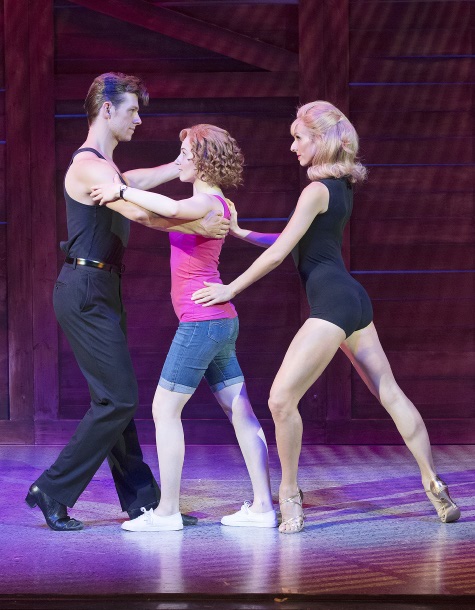
cast could not be faulted. They did all that was asked of them. Gillian
Bruce’s choreography demands a lot of all the dancers and they all
delivered with Lewis Griffiths as Johnny and Katie Hartland as Baby not
disappointing in their roles. A mention too for Megan Louch who stepped in to
the role of Penny for the indisposed Carlie Milner. Carlie must be quite
brilliant if she is better in the role than Megan, who was superb. Penny
is the dancer left pregnant by the rich boy, summer job, waiter and
Megan provides an air of innocence and vulnerability as well as a
sexiness that could start forest fires when she dances, which she does
exceedingly well There are some strong vocals from Jo Servi as
Tito, who was also on keyboards, Michael Kent as Billy and Daniela
Pobega as Elizabeth,. The Musicians’ Union were handing out leaflets
claiming that this was a scaled back production in terms of music with
just five musicians and backing tracks being used instead of double that
number as was the case in previous tours. Without arguing for or against the union the
music did suffer. The sound and tone from a live band working with the
singers or dancers is quite different from that created with backing
tracks which dictate the pace, the music leading the singers and
dancers, rather than following, creating more a karaoke than a
performance atmosphere. As a show it never
quite hit the heights but that being said it was an enjoyable evening,
with some excellent raunchy dancing, nostalgic music and remained
faithful to the plot of the movie and I am sure it will have fans of the
film happily smiling and humming (I’ve
had) The Time of my life as they head
off home. To 03-12-16 Roger Clarke 28-11-16
|
|
|
|
 as
enough in there for an audience to feel for the characters, even become
emotionally involved.
as
enough in there for an audience to feel for the characters, even become
emotionally involved.