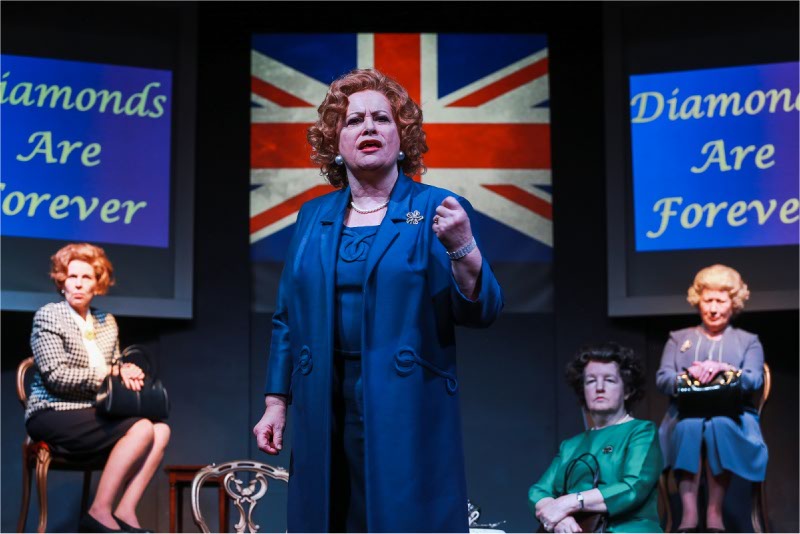
Carol Deakin as the younger Margaret Thatcher
with, behind, Pip Oliver as the older Maggie, left, Maura Judges as HRH
the younger and Denise Phillips as HRH the elder. Pictures: Emily
White
Handbagged
Highbury Theatre Centre
*****
Handbagged comes within a gnat’s
whisker, or perhaps in this case, whisper, of being quite brilliant.
It is fun, as sharp as anything Wilkinson’s or
Gillette could produce, witty, telling and for those of us of a certain
age, not so much history as memory.
This is a play about two powerful women, one a
grocer and tobacconist’s daughter who had a hand in inventing Mr Whippy
ice cream, married to a sausage maker executive; the other reputedly the
richest woman in the world, albeit much of her wealth in priceless
paintings and artworks, a £100m stamp collection, palaces and lands
being more in her stewardship rather than her ownership.
Margaret Hilda Thatcher and Elizabeth Alexandra
Mary Windsor, Prime Minister and Queen. Moira Buffini’s play employs
imagined conversations, comments and thoughts of the two protagonists
studded with a few genuine quotes and reports.
The premise coming over is that the Iron Lady, as
a Russian journalist dubbed her, was single minded in her belief of what
was best for Britain and the world, a belief that saw any left leaning
view, and it did not need to lean very far, as at best Communist at
worst terrorist. She was against unions, against Rhodesia becoming
Zimbabwe. uneasy about any independent African Commonwealth members and
even condemning ANC’s moves to end apartheid, resisting sanctions on the
all-white Pretoria Government.
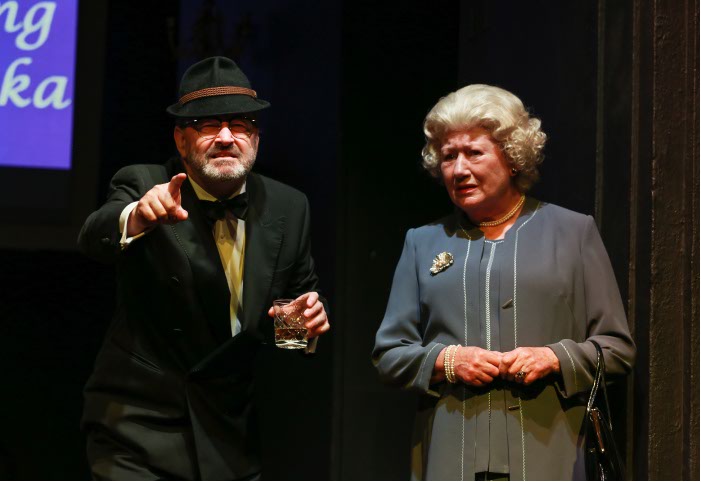
Ken Agnew as Denis Thatcher, glass in
hand, with Denise Phillips as Queen Elizabeth II
The Queen, on the other hand, despite unrivalled
wealth and privilege, at the very pinnacle of the Establishment, is seen
as almost left wing, a champion of the poor, the oppressed, the African
nations and indeed defending all her subjects in all corners of the
world. Her views she saw as not left wing or even political, but merely
Christian.
What happened in their weekly audiences we will
never know although the few utterances we were privy to, including a
Queen’s Christmas broadcast - apparently it is her only speech with no
Government influence - gives a little flavour of what might have
transpired, while rumours and speculation at the time suggested the pair
were hardly likely to become best friends, indeed becoming friends at
all, it seemed, would have been a considerable stretch.
The play depends upon an ensemble cast with Pip
Oliver superb as the older, less mobile and aging Thatcher, T, uncannily
capturing her intonation and looks as she speaks with that slow
deliberation and purpose.
Denise Phillips brings a regal air to her role as
her madge, Q, she has captured the voice, the clipped speech and the
gestures of the leader of the House of Windsor. An equally superb,
majestic foil to the Iron Lady.
.JPG)
Pip Oliver as Mrs Thatcher, circa 2010
They are now, or at least thet were in 2010 when
Handbagged was written, handbags being the symbol of authority for both
our leading ladies. Thatcher, who was to die three years later, was 85,
the Queen a year younger.
But their clashes, sorry, weekly audiences, came
in the 1980s, 30 years earlier, which brings in Carol Deakin as Mags and
Maura Judges as Liz, their younger selves, still with the same attention
to detail at their arm’s length weekly sparrings, with the older Mrs T
and HRH butting in with explanation, asides and objections from time to
time.
And around this duo of duos are the menfolk,
hundreds of them, but, times being hard, all played by Ken Agnew and
Paul Steventon-Marks.
Paul pops up, or more accurately shuffles and
limps in first as an ancient palace retainer serving tea to HM and PM,
he is also to give us Neil Kinnock, Nancy Reagan, a wonder to behold
(did she really have a beard?) and the Queen’s press secretary Michael
Shea and, to give an international flavour to proceedings, Zambian
president and Robert Mugabe mentor Kenneth Kaunda.
Ken, who argues vigorously for the role of
Kinnock, has to make do with Denis, permanent glass in hand and trilby,
cowboy President Reagan, urbane Peter Carrington and, the quiet, meek
and softly spoken and soon to be Thatcher assassin, Geoffrey Howe. He
also gives us one line – act 2, so look out for it – as Prince Phillip.
The pair being delightful light relief, not that
this is heavy going by any means, but they bring a different aspect, the
squabbling and rivalry between actors trying to make a living with their
collection of bit parts in a larger production.
Paul also adds an extra dimension, raising points
the script has apparently missed out, such as the miner’s strike which
riles both old and younger Thatcher demanding to know whose opinion the
audience have come to hear, and at this point it is perhaps no longer
hers that is of interest, but she is saved by the script, and the
miner’s strike becomes more an aside than an issue.
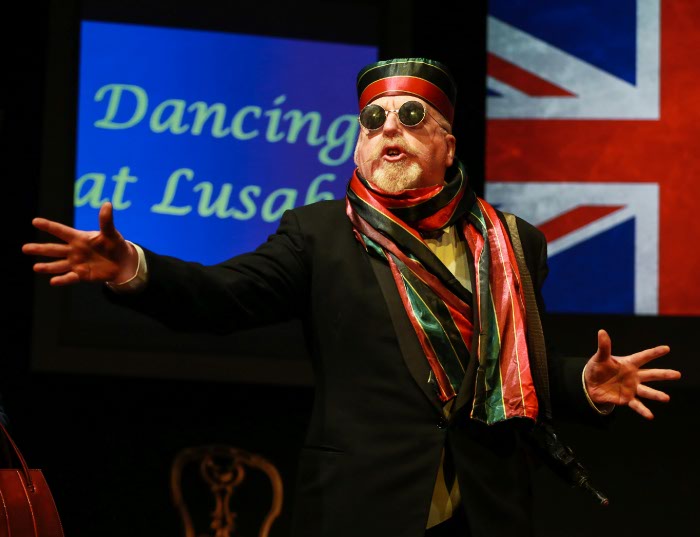
Paul Steventon-Marks brings Kenneth
Kaunda to the Commonwealth party, much to Mrs Thatcher's dismay.
Malcolm Robertshaw’s set is a minimalist delight,
three video screens to add context on the back wall, a raised platform
for HM and PM with the younger Thatcher and Queen sitting around a table
supplied with an endless supply of tea and scones and cakes with Reagan,
Kinnock, Uncle Tom Cobley or whoever flitting in from the wings or
merely changing a hat and character to add the next chapter to the
deliberations.
Steve Bowyer’s lighting highlights telling
moments while Tony Reynolds has used a job lot of patriotic music any
last night of the proms would be proud of.
Rob Phillips, so often in the spotlight, has
taken the directing reins and keeps what is a dialogue heavy play on the
lightest of tracks full of gentle, and not so gentle, digs, comments and
asides as the two most powerful women in Britain during the 80s go head
to head.
Its fun, thoughtful, entertaining and wonderful
theatre - a laugh out loud comedy with bite, One should not miss it as
one of our two stars might have said, so lets get going as the other
might have added. To 05-03-22.
Roger Clarke
01-03-22.
|