Stars explained: * A production of no real merit
with failings in all areas. ** A production showing evidence of not
enough time or effort, or even talent, and which never breathes any real
life into the piece – or a show lumbered with a terrible script. *** A
good enjoyable show which might have some small flaws but has largely
achieved what it set out to do.**** An excellent show which shows a
great deal of work and stage craft with no noticeable or major
flaws.***** A four star show which has found that extra bit of magic
which lifts theatre to another plane. Half stars fall between the ratings
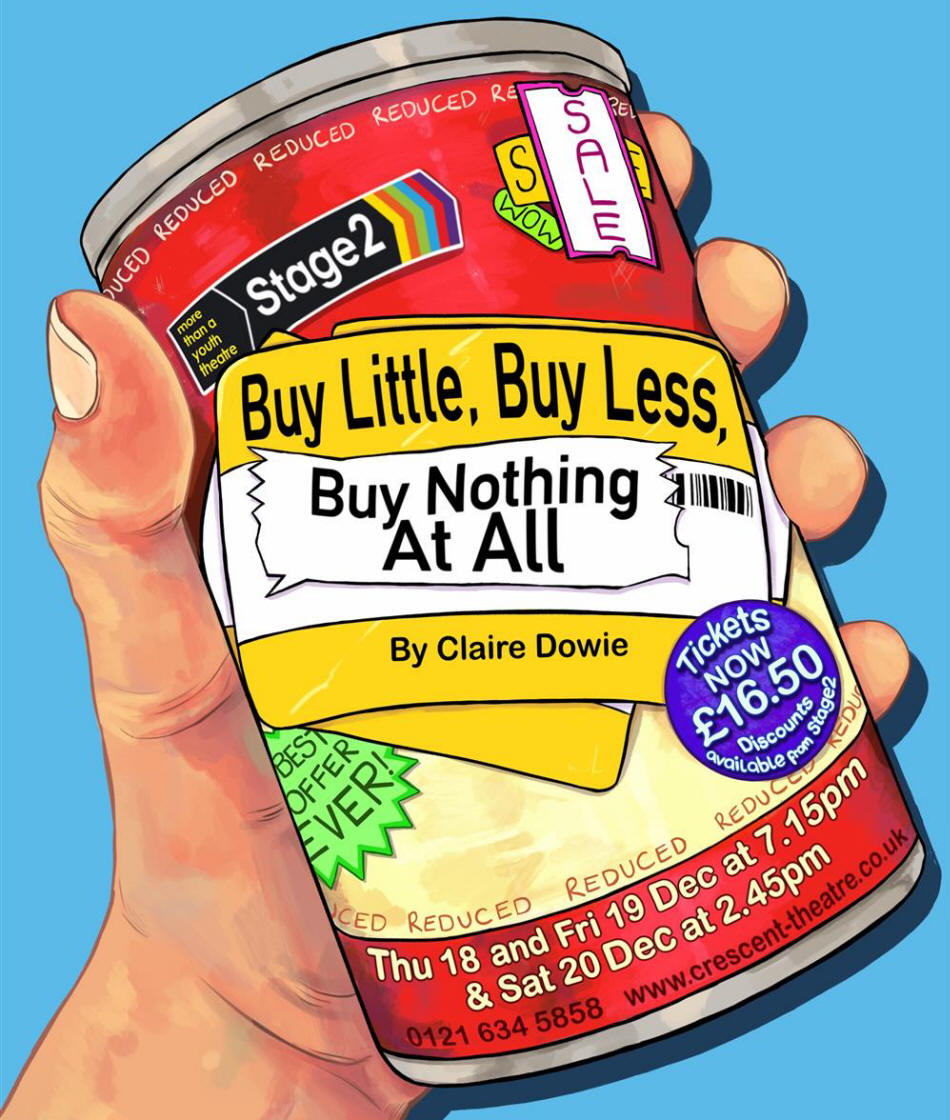
Buy Little, Buy Less, Buy Nothing At All
Stage2 Youth theatre
Crescent Theatre Studio
*****
Stuff . . . can we ever have enough? We live in a
world where red stickers, yellow labels, any % off are little more than
the bait of materialism in a spend, spend world exposed in Claire
Dowie's perceptive comedy of capitalism.
The comedy is dark at times and perhaps even
more telling at this time of year as we enter the shop till you drop
annual festival of consumerism.
If you are unsure of what the play is all about,
then Queen blasting out I Want It All might just be a clue. In a clever
start Jed . . . or Ted or Tim or Jim, (or Joseph Waide according
to the programme), stands in a darkened theatre and uses the beam from a
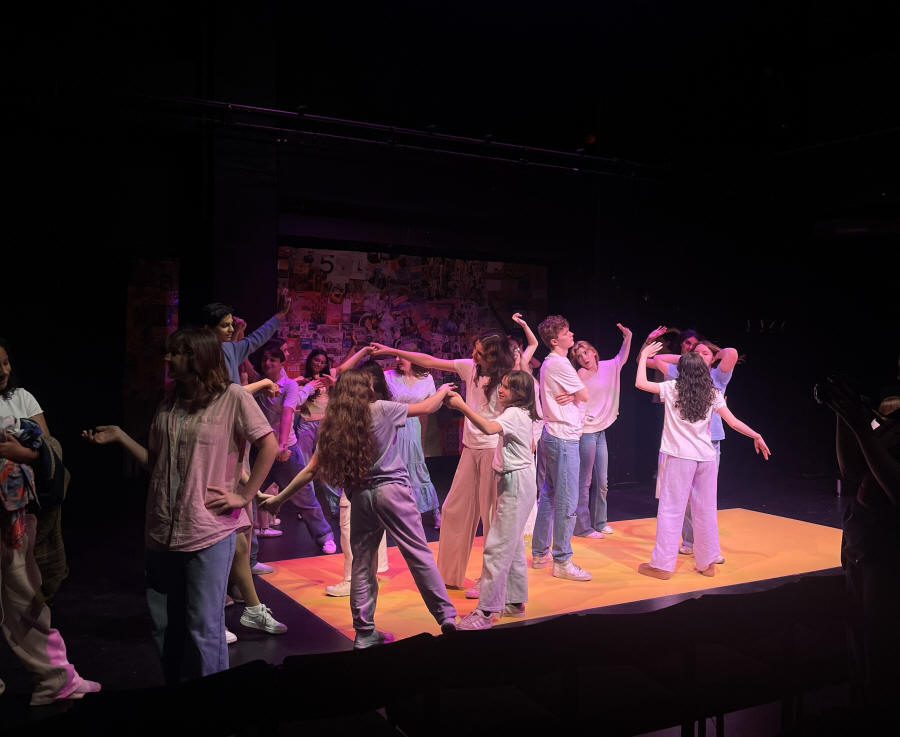
simple torch to highlight characters in the 36 strong cast - this really
is an ensemble piece - expressing their hopes, fears or merely
observations. Each picked out in turn, random thoughts in society's
jigsaw.
There is Casey James, lovestruck and overburdened
with Valentine's gifts, messy eater Evie McCabe, happy grandma Hannah
Rust and even Elliot Perrett risking excommunication from the consumer
society by using his imagination to turn a simple box into a racing car
. . . with no purchase involved.
It is all leading to . . . that mecca of
prudent(ish) purchase . . . Primark.
For those who never venture far from M&S, Primark
is at the Poundshop end of haute couture – high fashion(ish) on a low
budget, or tat, as our cast put it somewhat more succinctly.
Not that other chains and supermarkets remain
unscathed with M&S, we are told, having the remarkable ability to change
little girls into middle aged frumps merely by a visit to the shop to
use the toilet.
Amid Primark’s long-sleeved T-shirts for a fiver and the
£1 thongs that "look like hammocks for haemorrhoids" comes Phoebe
Preston to give us Andrea and a panic attack which starts a descent into
the chaos of capitalism and the need to collect . . . stuff.
And then there are the fads and fashions like
Aunt Alice and her digging for victory – whether she recognised victory
or not matters little as she carried on digging until she died, face
down in a cabbage, a sad fate, not unexpected at 96, recounted by
Nora Bownes, George Coley, George Humphries, Eloise Powell, Sebastian
Parker-Duber, Ruby Breakwell and Vinnie Stoiber.
As Alice had given herself to nature, keeping
chickens and bees and growing her own food, should she not have an
environmentally friendly carboard coffin? Except that was more expensive
than a traditional wooden one. Or perhaps she would prefer to be
composted? Although the regulations on the disposal of bodies might be a
problem.
She could be fed to the pigs which would be real
recycling and this also raised a philosophical question about that
particular avenue for disposing of the dearly departed in that it might
not be for everyone. We are reminded Jews and Muslims don't eat pork . .
. but can pork eat . . . who knows?
We are told of Judy Bergman by Ono Mazaheri,
Loaira Carvalhido Gilbert and Joseph Waide. She was a big American star,
and we mean big as in blocks out the sun big, and that brings us on to
dieting and healthy living with a five a day diet, no fags and living
longer which leads to a crisis in the NHS, which was healthily
funded by the unhealthy smokers
And healthy living with its fruit and veg regime
led on to the possibility of moments of, should we say, gastronomic
expression with the emphasis on the gas bit, and other bodily functions
and that took us on to toilets and toilet paper and a gran who cut up
the Daily Mail into neat squares to be spiked on a nail in the lav. It's
a toilet and it's paper, so what more could you ask? Well perhaps a
higher class of newspaper . . . after all, even bottoms deserve a
modicum of dignity.
Throw in sell by dates and dumpster diving with
Tabaarak Pathan, Mark Smith-Alonso, Frankie Rock, Elliot Perrett and
Phoebe Preston going through supermarket waste bins where sell by dates
reign supreme while Casey James and Bella Bailey found new meaning in
train travel and Joseph Waide, Aleksander Harney, Hannah Rust, Leena
Patel, Rose Gilliam, Tom Wallace, Rudy Hudson and Molly Oldershaw
introduced us to night shopping.
When it came to choice, if we have any, that
brought in Kitty Bateman, Alice Heyes, Hester Hawley, Pearl Gunn, Mark
Smith-Alonso and Tabaarak Pathan.
And remember Phoebe Preston's Andrea. . . she
bought thong after thong that she neither needed nor even wanted, but .
. . £1 . . . bargain! The pressure of buying and buying, amassing
stuff defining who we are creating its own identity crisis highlighting
our own contradictory conflict of wanting less and buying more explained
by Phoebe, Clara Smith, Evie McCabe and Herbie Oldershaw.
All were aided by a chorus of Leesha Rose Talwar,
Heidi Wells, Andrew Micdan, Kit Webster and Gabriella Benito.
It is always a pleasure to watch Stage2, with Liz
Light still at the helm after 37 years. They are a joy to watch, full of
enthusiasm and unpaid, unbridled professionalism. Old hand Liz
guided 18-year-old Jacob Lenton in directing the play with a pleasing
pace, innovation and all the superb timing and efficiency needed with 36
people on stage at the same time - never a mob but a cast who are always acting whenever
they step on stage.
Theatre is not just
about those in the spotlight though and each Stage2 production, indeed
any theatre production, has its unsung heroes, the tech team behind
every performance, in this case ex-members Joseph Hack-Myers (sound) and
Daisy Wilkes (lighting) created the well balanced and telling technical
designs
for lighting and sound operators James Woodman and Lewis Grego to put
into practice with stage managers Alonzo Holbrook and Thom Halward
completing the team making sure everything and everyone is in the right
place at the right time. Unlike actors their success lies in not being
noticed and we noticed nothing at all.
The plays started as a monologue by Birmingham
born actress and writer Claire Dowie, but there is a long standing
relationship between her and Stage2, who have performed a number of her
telling works, and Stage 2 don't do monologues . . . so the play was
adapted to a large cast and uprooted from London to Birmingham and
Claire even came and workshopped the cast.
At a time of year when commercialism reigns there
is an element of satire in what is a wonderful production which ends
20-12-25.